I started writing this post at the beginning of my move from London to Singapore, almost a month ago now. I am already back in Singapore, but the rest of my stash (and stuff) are in transit for another two months or so.
Packing knitting for a trip takes me much much more time than packing my clothes.
How on earth am I supposed to predict what I will feel like knitting days or even weeks from now? I know what I SHOULD be working on, of course, but I've tended to find that bringing projects I'm not excited about tends to lead to an absence of knitting.
This post is about packing for general travel (up to 3 weeks), but I will write a bit more about my experiences packing for extended travel next week.
#1 Variety, Variety, Variety
I like to pack at least 3 kinds of projects, which usually means at least one lace shawl and at least one garment, since that's pretty much all I knit. If I knitted socks, I'd definitely have one of those too.
#2 Think About Your Environment
I was moving straight into an empty apartment, with the intent to buy lights and furniture as needed, so I didn't worry too much about that this time. But normally, when I travel, I make sure not to pack items that require good light to work on.
So pass on the cobweb yarns and bring on the fingering and up yarns. Stay away from dark colors that are difficult to see.
#3 Bring a Needle set!
Sometimes you cast something on, and you realise your gauge is off. It's just easier to travel with the whole set.
#4 Bring Some Yarn!
Just in case you feel like casting on something new, you should bring something new. In #1, I said I usually pack 3 kinds of projects, and usually the third is something new. :)
#5 Buy Some Yarn!
We all deserve souvenir yarn!

Thursday, 14 December 2017

Monday, 20 November 2017
May Made: Apex Cardigan II
This is my first lever knitting project, but I will talk about the lever knitting aspects separately.
The Making

The beginnings of my second Apex.
I must be crazy, but this is the second Apex Cardigan I have made this year. I learnt quite a lot from the first one I made.
I exaggerated all the things I loved about the first one.
I made it wider. This emphasized the drop shoulder aspect, and will also allow me to use a shawl pin to hold the fronts closed if it gets particularly cold.
I also chose to knit it as long as I could given the amount of yarn I had, after seeing Ririko's version. It definitely reduces that weird bump I had on the back too.
But I think the best thing I did for my second version is to use a much drapier yarn and fabric. I think it looks more elegant and feminine this way.
I actually did knit the pockets, but the yarn I'm using is somewhat puffy, and it looked oddly bumpy at the hips, so I took them out.
The Materials
I used Illimani Amelie, which the proprietor of Illimani, Alvaro, kindly agreed to sell directly to me, even though he normally only does wholesale.
Amelie is a blown yarn. They make it by knitting a silk tube, and blowing it full of lovely alpaca fiber. You get 150m per 50g and it still knits up at a true worsted-aran gauge. This makes it extraordinarily light compared to most aran yarns.
And it feels absolutely glorious. This yarn deserves to be a next-to-skin garment. I very much would love to keep this cardigan as a house coat, and if I did that, I would only wear shorts and spaghetti strap tops at home to keep as much of the cardigan next to my skin as possible. I am currently working on a cashmere-silk shawl, and I firmly believe that Amelie feels much nicer.
The Wearing
I have to admit, there is not anything new here. I made it long enough to be a proper Swoat, unlike my first one, and that's about it.
But here are some photos of me posing with it after I did the Three Needle Bind-off for the body, but without side seams or sleeves.

I put the cardigan back in front, and tied the cardigan fronts to wear this as an apron. I'm just going to pretend that Olga found this funny. :D

I briefly, but seriously, considered keeping it as a cape.
If I hadn't already finished the sleeves, I might actually have left it like this. Linda Marveng's Wa has a similar sort of shape. If you would like to use the Apex pattern to make something like the Wa, I would recommend using the largest size chart, because it is not wide enough to even cover my upper arms like this.
 View from the back.
 With the matching scarf I made to keep my front warm.
The Notes
I am of the opinion that this design looks better oversized and long, maybe more so than in the modeled pictures. Despite using a bigger gauge this time, I actually still went up a size in width (from 40 to 42). The main thing is, you probably want to make sure that the drop shoulder ends before your elbows begin. It will be less in your way.
If you should attempt to try it on after joining the fronts and back and blocking, it should be longer than you need it to be. The seams will 'pull up' the hem.
Choose your yarn, gauge and fabric wisely. This is a great project for choosing your own gauge, so rely on your preferences rather than worrying about getting gauge. The only thing I dislike about my drapier gauge is that the cables are not popping as much.
The Making
The beginnings of my second Apex.
I must be crazy, but this is the second Apex Cardigan I have made this year. I learnt quite a lot from the first one I made.
I exaggerated all the things I loved about the first one.
I made it wider. This emphasized the drop shoulder aspect, and will also allow me to use a shawl pin to hold the fronts closed if it gets particularly cold.
I also chose to knit it as long as I could given the amount of yarn I had, after seeing Ririko's version. It definitely reduces that weird bump I had on the back too.
But I think the best thing I did for my second version is to use a much drapier yarn and fabric. I think it looks more elegant and feminine this way.
I actually did knit the pockets, but the yarn I'm using is somewhat puffy, and it looked oddly bumpy at the hips, so I took them out.
The Materials
I used Illimani Amelie, which the proprietor of Illimani, Alvaro, kindly agreed to sell directly to me, even though he normally only does wholesale.
Amelie is a blown yarn. They make it by knitting a silk tube, and blowing it full of lovely alpaca fiber. You get 150m per 50g and it still knits up at a true worsted-aran gauge. This makes it extraordinarily light compared to most aran yarns.
And it feels absolutely glorious. This yarn deserves to be a next-to-skin garment. I very much would love to keep this cardigan as a house coat, and if I did that, I would only wear shorts and spaghetti strap tops at home to keep as much of the cardigan next to my skin as possible. I am currently working on a cashmere-silk shawl, and I firmly believe that Amelie feels much nicer.
The Wearing
I have to admit, there is not anything new here. I made it long enough to be a proper Swoat, unlike my first one, and that's about it.
But here are some photos of me posing with it after I did the Three Needle Bind-off for the body, but without side seams or sleeves.
I put the cardigan back in front, and tied the cardigan fronts to wear this as an apron. I'm just going to pretend that Olga found this funny. :D
I briefly, but seriously, considered keeping it as a cape.
If I hadn't already finished the sleeves, I might actually have left it like this. Linda Marveng's Wa has a similar sort of shape. If you would like to use the Apex pattern to make something like the Wa, I would recommend using the largest size chart, because it is not wide enough to even cover my upper arms like this.

The Notes
I am of the opinion that this design looks better oversized and long, maybe more so than in the modeled pictures. Despite using a bigger gauge this time, I actually still went up a size in width (from 40 to 42). The main thing is, you probably want to make sure that the drop shoulder ends before your elbows begin. It will be less in your way.
If you should attempt to try it on after joining the fronts and back and blocking, it should be longer than you need it to be. The seams will 'pull up' the hem.
Choose your yarn, gauge and fabric wisely. This is a great project for choosing your own gauge, so rely on your preferences rather than worrying about getting gauge. The only thing I dislike about my drapier gauge is that the cables are not popping as much.
Thursday, 2 November 2017
Lever Knitting: A Series
While I have been away from the blog recently, my big project has been learning how to lever knit.
I am almost done with my first lever knitting project, so I think it's a good time to start writing about it. I hope that the husbear will also be able to take some video of me lever knitting.
I'll be touching on the following topics, and I'll cheerfully answer any additions to the list that you might like to see:
I am almost done with my first lever knitting project, so I think it's a good time to start writing about it. I hope that the husbear will also be able to take some video of me lever knitting.
I'll be touching on the following topics, and I'll cheerfully answer any additions to the list that you might like to see:
- Speed
- Ergonomics
- Convenience
- Quality of fabric
- Pros and cons vs other styles of knitting
- Choice of needles
Wednesday, 25 October 2017
I am Mathemaknitter
I have changed the blog title and URL to better reflect what I really like talking about.
Which is math and knitting. And there will be bits of programming thrown in, now that I've sorted out some technical issues.
The thing is, I just have so much more to say about math and fit and knitting than picking out the perfect capsule wardrobe.
I have also changed my username on instagram and Ravelry to mathemaknitter.
I have to say, I'm surprised that nobody has thought of this username before.
In any case, I hope to be back in a few days with something more substantial. I did finish a shawl, two cardigans, the body of a shrug and a Modified Shawl Thing since I last wrote anything substantial.
Which is math and knitting. And there will be bits of programming thrown in, now that I've sorted out some technical issues.
The thing is, I just have so much more to say about math and fit and knitting than picking out the perfect capsule wardrobe.
I have also changed my username on instagram and Ravelry to mathemaknitter.
I have to say, I'm surprised that nobody has thought of this username before.
In any case, I hope to be back in a few days with something more substantial. I did finish a shawl, two cardigans, the body of a shrug and a Modified Shawl Thing since I last wrote anything substantial.
Monday, 2 October 2017
Speedy Lace Knitting
(I'm writing this brief post for /u/FelidarSovereign.)
In this post, segments and repeats are different things.
Square shawls knitted in the round usually have 4 segments, but often have repeats of any number of stitches within each segment.
1. Knit in the round
Most people knit faster than they purl, particularly if they knit continental.
I find that garter lace is harder to fix, despite having been playing around with it for awhile. Many traditional garter lace patterns also have wrong-side patterning, which is troublesome for lifelines if you need them.
Knitting in the round also has the advantage that as your rows grow larger, you will not have to turn your work.
2. Minimise beading
Beading is pretty slow, unless you pre-string, but I have not worked with pre-strung before as I knit with very fine yarn, and I worry about the wear and tear on the yarn.
3. Choose your Left Leaning Decrease wisely
I use the SSK variation that Brooklyn Tweed recommends in their patterns, because it is very fast. I believe I first came across this in Permafrost by Jared Flood. Slip the first stitch as if to knit, then knit it and the next stitch together through the back loop. Naturally, if you need a 2-stitch left leaning decrease, you slip the first stitch, then knit it and the next 2 stitches together through the back loop and so forth.
If you're using yarn that is at least 1300m per 100g, I advocate just knitting or purling the stitches together through the back loop. You will not be able to tell the difference anyway.
4. Decrease in one movement
When you k2tog/k3tog/kxtog, it's about as fast as any other knit stitch.
One of the reasons why I like BT's SSK variation (see point 3 above) is that it is very easy to knit it in one movement, none of this passing stitches back and forth nonsense.
You can also do a CDD and other multi-stitch decreases in this manner. I actually find this to be easier to achieve with finer yarns.
This is important to speed because lace patterning is the result of planned decreasing and increasing, and the more intricate the lace, the more decreasing there will be.
5. Short repeats
Short repeats are faster to memorise, and require less checking back and forth with the chart/instructions.
You will likely also find that you will be much faster at finding mistakes when you need to.
6. Use fewer stitch markers
I am not advocating skipping them altogether, but for a shawl knitted in the round, I will typically only use stitch markers for every segment. For instance, a square knitted in the round usually has 4 segments, so I will have 4 stitch markers.
I am currently binding off a circular shawl that has 210 patterned rows, and is 8 segments in the round. I slipped markers 1680 times, but if I had a stitch marker every 20 stitches, plus for one to mark each segment, I would be slipping markers over 6000 times.
7. Provisional cast on for Very Fine Yarns
I recommend that if you are knitting flat with very fine yarn that you consider doing a COWYAK.
One of the problems with very fine yarn is that at the beginning, it is difficult to read your knitting because there is not enough weight to stretch out the yarn a little. This means you will use your fingers to do it, which is an additional strain and will slow you down.
Using a COWYAK with a slightly heavier yarn will give you that weight at the beginning. I recommend doing at least 5 or 6 rows, maybe more, because if you do need to stretch out your knitting to read it, it will also give you a 'handle' to use.
It will not be too heavy to stress the yarn, as once it is long enough, the COWYAK will just rest on your lap.
Additionally, you will be able to bind off both sides the same way, which will look nicer.
8. Wool and Animal Fibres are Queen
Elastic fibres make it easier for decreasing. This is really important because there is so much decreasing in lace.
It is also crucial to point 4 above. Decreasing in one movement with linen or cotton is more difficult than with wool or alpaca.
9. Skip the Knitted-on Border
I know they are traditional and pretty, but they are also slow and tedious and it is like sleeve island: it happens after the rest of it is done.
10. Knit Every Day
If you work on it every day, it will be easier for you each time you pick up the project again, especially if the pattern is repeating a lot.
In this post, segments and repeats are different things.
Square shawls knitted in the round usually have 4 segments, but often have repeats of any number of stitches within each segment.
1. Knit in the round
Most people knit faster than they purl, particularly if they knit continental.
I find that garter lace is harder to fix, despite having been playing around with it for awhile. Many traditional garter lace patterns also have wrong-side patterning, which is troublesome for lifelines if you need them.
Knitting in the round also has the advantage that as your rows grow larger, you will not have to turn your work.
2. Minimise beading
Beading is pretty slow, unless you pre-string, but I have not worked with pre-strung before as I knit with very fine yarn, and I worry about the wear and tear on the yarn.
3. Choose your Left Leaning Decrease wisely
I use the SSK variation that Brooklyn Tweed recommends in their patterns, because it is very fast. I believe I first came across this in Permafrost by Jared Flood. Slip the first stitch as if to knit, then knit it and the next stitch together through the back loop. Naturally, if you need a 2-stitch left leaning decrease, you slip the first stitch, then knit it and the next 2 stitches together through the back loop and so forth.
If you're using yarn that is at least 1300m per 100g, I advocate just knitting or purling the stitches together through the back loop. You will not be able to tell the difference anyway.
4. Decrease in one movement
When you k2tog/k3tog/kxtog, it's about as fast as any other knit stitch.
One of the reasons why I like BT's SSK variation (see point 3 above) is that it is very easy to knit it in one movement, none of this passing stitches back and forth nonsense.
You can also do a CDD and other multi-stitch decreases in this manner. I actually find this to be easier to achieve with finer yarns.
This is important to speed because lace patterning is the result of planned decreasing and increasing, and the more intricate the lace, the more decreasing there will be.
5. Short repeats
Short repeats are faster to memorise, and require less checking back and forth with the chart/instructions.
You will likely also find that you will be much faster at finding mistakes when you need to.
6. Use fewer stitch markers
I am not advocating skipping them altogether, but for a shawl knitted in the round, I will typically only use stitch markers for every segment. For instance, a square knitted in the round usually has 4 segments, so I will have 4 stitch markers.
I am currently binding off a circular shawl that has 210 patterned rows, and is 8 segments in the round. I slipped markers 1680 times, but if I had a stitch marker every 20 stitches, plus for one to mark each segment, I would be slipping markers over 6000 times.
7. Provisional cast on for Very Fine Yarns
I recommend that if you are knitting flat with very fine yarn that you consider doing a COWYAK.
One of the problems with very fine yarn is that at the beginning, it is difficult to read your knitting because there is not enough weight to stretch out the yarn a little. This means you will use your fingers to do it, which is an additional strain and will slow you down.
Using a COWYAK with a slightly heavier yarn will give you that weight at the beginning. I recommend doing at least 5 or 6 rows, maybe more, because if you do need to stretch out your knitting to read it, it will also give you a 'handle' to use.
It will not be too heavy to stress the yarn, as once it is long enough, the COWYAK will just rest on your lap.
Additionally, you will be able to bind off both sides the same way, which will look nicer.
8. Wool and Animal Fibres are Queen
Elastic fibres make it easier for decreasing. This is really important because there is so much decreasing in lace.
It is also crucial to point 4 above. Decreasing in one movement with linen or cotton is more difficult than with wool or alpaca.
9. Skip the Knitted-on Border
I know they are traditional and pretty, but they are also slow and tedious and it is like sleeve island: it happens after the rest of it is done.
10. Knit Every Day
If you work on it every day, it will be easier for you each time you pick up the project again, especially if the pattern is repeating a lot.
Thursday, 8 June 2017
Summer of Basics
Basics are what I'm missing from my wardrobe, especially good quality ones.
So Fringe Association's Summer of Basics is right up my alley. The goal is to make 3 items over 3 months that will be wardrobe essentials for you.
I'm aiming to make 1 set each of sewn and machine-knitted garments.
I have 3 dress patterns, so the sewn things are taken care off. I might shorten them a little to make tops or tunics, but that's about it.
It's the machine knitted garments that are maybe more interesting.
#1: Palmer by Michele Wang.

Photo copyright Brooklyn Tweed.
I've made significant progress on swatching and doing math to make this on the machine, because I'm clearly not knitting this much stockinette ever.
I am, however, undecided on whether to rib the hem, cuffs and so forth. It'll be a loooooooong project in single stranded in 2/14nm yarn. I'll most likely swatch with garter knitted sideways, and then ribbing both single and double stranded.
I do have some time to decide though. I plan to do all the ribbing for the fronts and hem at the same time, in one go, so I can mitre the corners of the bottom fronts.
#2: Sweater Blank by Renee Callahan
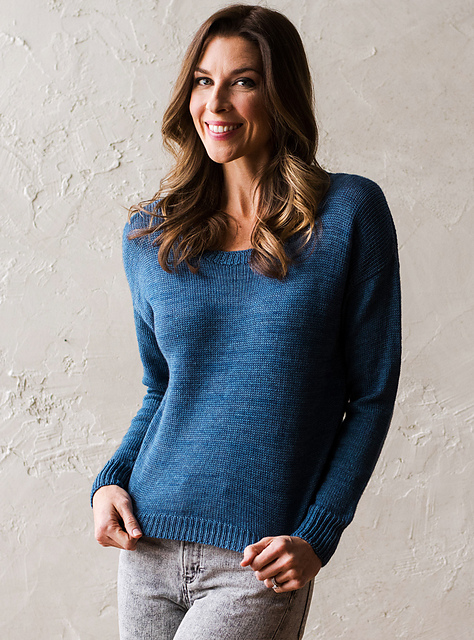 Photo copyright Craftsy.
I want one of these with loads of positive ease, kind of like a Boxy. I have swatched already too.
#3: Custom Fit?
I don't know which pattern, but I have been thinking that this might be a good time to try Custom Fit out. Possibly with a tuck stitch pattern. My back up plan is to make an Infinite Loop, since I already have a plan for it.
So Fringe Association's Summer of Basics is right up my alley. The goal is to make 3 items over 3 months that will be wardrobe essentials for you.
I'm aiming to make 1 set each of sewn and machine-knitted garments.
I have 3 dress patterns, so the sewn things are taken care off. I might shorten them a little to make tops or tunics, but that's about it.
It's the machine knitted garments that are maybe more interesting.
#1: Palmer by Michele Wang.
Photo copyright Brooklyn Tweed.
I've made significant progress on swatching and doing math to make this on the machine, because I'm clearly not knitting this much stockinette ever.
I am, however, undecided on whether to rib the hem, cuffs and so forth. It'll be a loooooooong project in single stranded in 2/14nm yarn. I'll most likely swatch with garter knitted sideways, and then ribbing both single and double stranded.
I do have some time to decide though. I plan to do all the ribbing for the fronts and hem at the same time, in one go, so I can mitre the corners of the bottom fronts.
#2: Sweater Blank by Renee Callahan
I want one of these with loads of positive ease, kind of like a Boxy. I have swatched already too.
#3: Custom Fit?
I don't know which pattern, but I have been thinking that this might be a good time to try Custom Fit out. Possibly with a tuck stitch pattern. My back up plan is to make an Infinite Loop, since I already have a plan for it.
Wednesday, 7 June 2017
A Standard Swatch
One of the best things about machine knitting is the ease of swatching.


Some labeled swatches. 2 of them are hand-knitted.
It's allowed me to experiment more with my yarns, and the fabric that I can create.
I've been doing a lot of swatching as a result. In fact, whenever I get a new yarn that I want to test on the machine, I make a standard swatch.
I cast on 40 stitches with e-wrap, knit 40 rows as a specific tension, and then cast off. I tag my swatches, measure the gauge, weight and size.

4-ply Acrylic.I expect to use this yarn for experiments with texture and cables.

2/14nm 70/30 yak hair/wool. Scrumptiously soft. I will be writing more about using this to make a light cardigan, I hope.

Some labeled swatches. 2 of them are hand-knitted.
I will be reporting on my experiments with tension in a few days, I hope.
Subscribe to:
Posts (Atom)